Most people think health is the destination.
I don't.
I think it's the passport.
A passport doesn't tell you where you have to go.
It gives you the ability to go.
That's increasingly how I think about health.
There was a time when fitness was mostly about being fit.
Getting stronger.
Looking good.
Feeling good.
Being able to ride farther and faster.
And if I'm being truthful, I still care about all of those things.
Who doesn't want to look younger?
Who doesn't want to feel confident when they look in the mirror?
I'll happily take both. 😂
But as I've gotten older, I've realized I'm training for something much bigger.
Freedom.
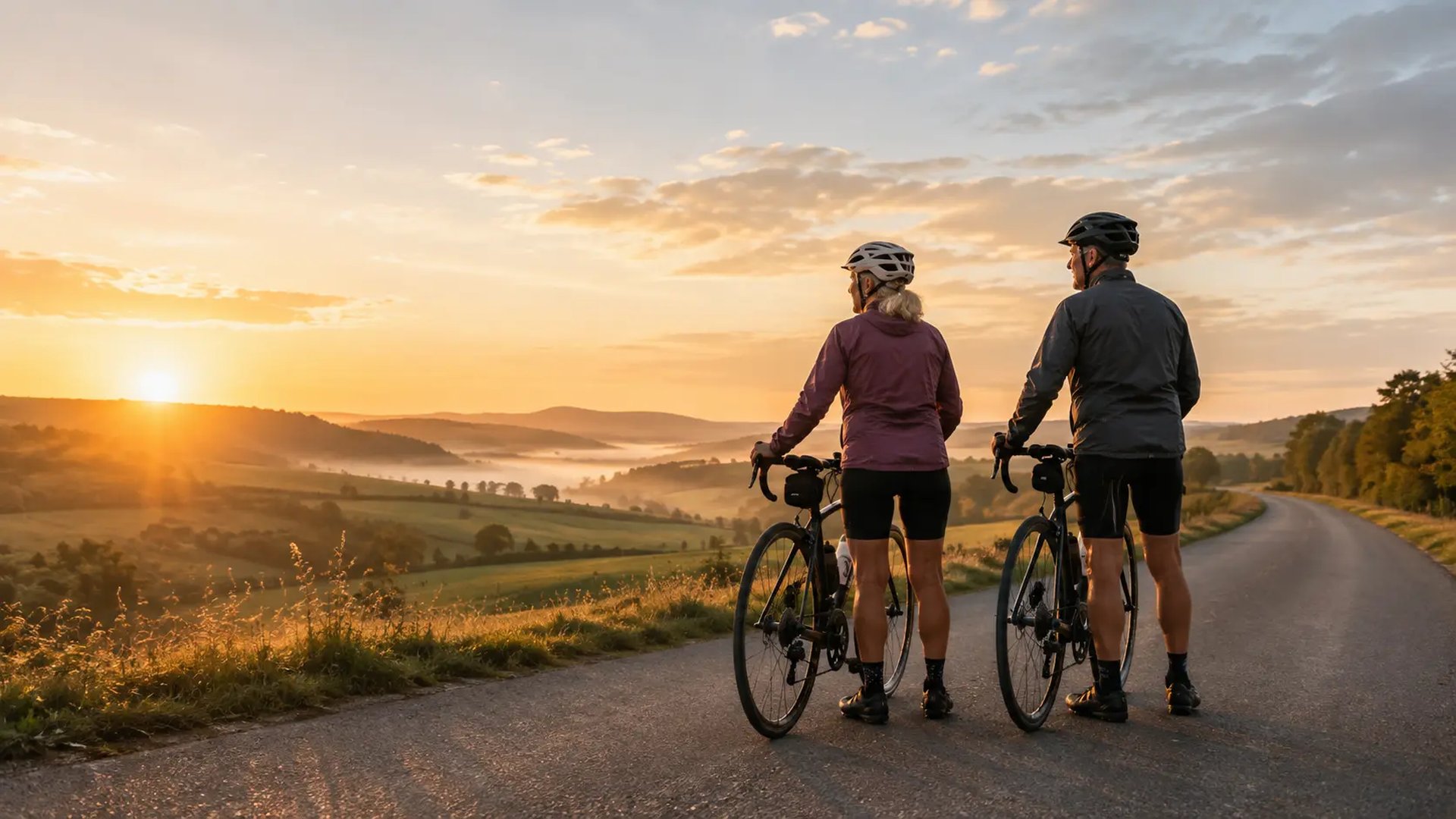
The freedom to ride my bicycle.
To travel somewhere new and spend the day exploring.
To take a fitness class, organize an event or keep up with friends.
To work on an idea when I'm excited about it.
To keep building something meaningful.
To say yes when something interesting comes along.
The real reward is having the freedom to keep saying yes to life.
Yes to another trip.
Yes to another bike ride.
Yes to learning something new.
Yes to another dream.
Yes to an adventure you haven't even imagined yet.
That's what health increasingly means to me.
Not perfection.
Possibility.
I know how old I am. I just don't feel it.
I'm 61.
I know what the calendar says.
But most days, I don't feel 61.
In my head, I still feel like I'm somewhere in my 30s.
I'm still curious.
Still competitive.
Still excited about new ideas.
Still interested in meeting people, travelling, building things and trying something I haven't done before.
And definitely still interested in having fun.
I'm not trying to pretend I'm younger than I am.
I'm trying to protect my ability to live the way I still want to live.
There's a difference.
Not because I'm afraid of getting older.
Because I'm excited about everything that's still ahead.
When I discovered cycling, I thought I was buying a bicycle
I wasn't.
I was opening a door.
Cycling brought unexpected friendships into my life.
It took me to places I probably never would have discovered otherwise.
It challenged me.
It humbled me.
It gave me confidence.
It introduced me to people from different countries and backgrounds.
It became part of my community.
And eventually, it influenced some of the things I'm building today.
That's a pretty big return from buying a bicycle.
When I ride now, I'm not thinking only about exercise.
I'm thinking about exploring another road.
Laughing with friends.
Discovering another small town.
Feeling the wind on my face.
Coming home with another story.
Cycling changed my life partly because I became healthy enough to say yes to experiences I once would have missed.
And one particular ride in Italy reminded me exactly what that means.
San Marino reminded me what fitness is really for
We were riding to San Marino, the tiny independent country surrounded by Italy.
Getting there by bicycle involved something cyclists understand very quickly.
Hills.
Lots of them.
There are hills.
And then there are more hills. 😂
It was a challenging climb.
But that's part of why I remember it.
You're working.
You're climbing.
Your legs know exactly what you're doing.
And eventually you arrive somewhere you earned your way into.
What stayed with me wasn't a number on my bike computer.
It was the experience.
The climb.
The view.
The people.
The feeling of being somewhere remarkable and knowing I'd arrived there under my own power.
I wasn't thinking about my age.
I was thinking about how fortunate I was to be able to do it.
That's when fitness becomes something more than exercise.
Fitness gives you access to experiences.
And the older I get, the more valuable that feels.
Capability changes the conversation
There are plenty of things about ageing we can't control.
I'm not interested in pretending otherwise.
But I also don't want to hand decisions over to my age before I need to.
I don't want to see an interesting trip and immediately think, Am I too old for that?
I don't want to see a climb and automatically assume it's no longer for me.
I'd rather ask:
When are we going?
For me, being physically capable might mean getting on my road bike.
Walking around a European city for hours.
Going to the gym.
Taking a fitness class.
Travelling.
Organizing something for the community.
Spending an active day with friends.
Or still having enough energy to work on an idea I'm excited about.
Together, those things describe something I value enormously.
A life with options.
And options are the whole game.
Not because every option gets used.
Because the ones you still have are the ones you get to choose from.
The years we add aren't automatically good years
Here's something I didn't think about much until my fifties.
Living longer and staying capable are two different projects.
The World Health Organization tracks both. It measures life expectancy, which is how long we live, and healthy life expectancy, which is roughly how many of those years we can expect to spend in good health. Before the pandemic, global life expectancy had climbed past 73 years, while healthy life expectancy sat around 63 and a half. Both fell back afterwards. But the more telling detail is that across two decades, the healthy years didn't grow as quickly as the total years. Most of the gain came from living longer, not from spending less of life unwell.
So there is a gap.
And the gap is where a lot of life quietly gets lost.
That's what nobody puts on a birthday card. We talk about how long we'll live. We rarely talk about what those years will actually contain.
Because a year isn't just a year.
A year where you can climb three flights of stairs without thinking about it is not the same as a year where you plan your day around them.
A year where you can carry your own luggage through an airport is not the same as a year where the trip starts to feel like too much trouble.
A year where you can work on something you care about, sit through a long conversation, get down on the floor with a grandchild, walk a city you've never seen, say yes to a last-minute invitation — that's a different year entirely.
This is really the same gap I've written about as the difference between living longer and living well, and it's one of the most interesting questions of our generation.
I'm not trying to win the longevity contest.
I'm trying to keep the years usable.
What you lose if you do nothing in particular
The part that surprised me most is how undramatic the loss is.
Nobody wakes up unable to do things.
There's no announcement.
A 2023 review in the physiology literature pulled together dozens of studies comparing muscle size in adults in their twenties with adults in their seventies. Across major muscle groups, the older adults had meaningfully less muscle — in some groups roughly a fifth less, working out to a fraction of a percent per year. That's the important part. A fraction of a percent a year is invisible. It's also cumulative.
And most of us aren't doing much to offset it. When Statistics Canada released the latest results of the Canadian Health Measures Survey in October 2025, adults were spending an average of 9.3 hours a day sedentary. Fewer than half met physical activity recommendations. And only about 39% had done any strength training on two or more days in the previous week.
Strength is the thing most of us skip.
It's also the thing that carries the suitcase.
I don't think about that as a health statistic. I think about it as a sequence.
A little less strength.
A little less confidence.
One activity becomes slightly inconvenient.
Then it becomes something you'd rather not do.
Then it becomes something you don't do anymore.
And nothing dramatic ever happened.
The world just got a little smaller each time.
That's what I'm actually trying to avoid. Not a number on a chart. The slow narrowing of what's still available to me.
And yes, looking good counts
There's a tendency when people talk about fitness as they get older to pretend appearance doesn't matter anymore.
Come on. 😂
Of course it matters.
I like being fit.
I like looking fit.
I like feeling confident in my clothes.
And yes, if staying active helps me look younger, I'll take that too.
I don't think there's anything wrong with admitting it.
But appearance isn't the biggest reward.
Capability is.
Looking fit feels good.
Being capable feels even better.
Because capability travels with you.
It goes up the hill with you.
It walks through the airport.
It explores the city.
It gets on the bicycle.
It shows up for the people in your life.
And it creates a kind of confidence that has very little to do with a mirror.
It's the confidence of knowing you're still able to participate.
I'm training for an older version of myself who still wants to do things.
What am I really training for?
Most people don't wake up excited to exercise.
I don't always.
There are days when going to the gym sounds less appealing than doing almost anything else.
But I've stopped thinking about exercise as something I'm simply supposed to do.
We don't exercise because we love exercising. We exercise because we love living.
When I think about getting older, I'm less interested in chasing a particular age than I am in preserving capability.
At 70, can I still cycle?
Can I travel comfortably?
Can I spend a day exploring somewhere new?
Can I keep up with friends?
Can I lift things?
Can I try something I've never done before?
Can I still have the energy to build something?
When I put it that way, four questions do most of the work for me.
Strength. Not a number on a machine. Can I carry things, lift things, get up off the floor and handle my own life without asking someone else to do it for me?
Cardiovascular capacity. Not a performance metric. Can I take the hill, the stairs, the airport, the long day, the ride — and keep up with the people I enjoy being around?
Mobility. Can I get onto a bicycle, into a vehicle, down onto the floor with a child and back up again without negotiating with my own body?
Recovery. Can I do it again tomorrow? Because most of the good things in life — trips, projects, weekends with people you love — aren't one day. They're several in a row.
I don't have a programme for any of that, and I'm not going to pretend to write one for you. Health organizations have already published sensible general guidance, and it's not complicated: move regularly, and include something that makes you stronger.
The useful part isn't the schedule.
It's the decision underneath it.
Decide what you want to remain capable of doing, then train for that life.
I don't know exactly what the next twenty years of my life will look like.
None of us does.
But I know I want more adventures.
More friendships.
More places I've never seen.
More things to learn.
More things to build.
And more opportunities to encourage someone who wonders if their best years are behind them.
None of those dreams requires perfection.
They require enough health to keep saying yes.
It is genuinely not too late
This is the question I hear most often, usually phrased almost apologetically.
What if I'm starting at 55?
At 60?
At 68?
Here's what the evidence actually says, and it's more encouraging than most people expect. The World Health Organization's guidance for older adults doesn't treat activity as damage control. It recommends varied activity that includes balance and strength work several days a week specifically to improve functional capacity, because the research shows older adults who do it see gains in strength, balance, flexibility and cardiovascular fitness — and fewer falls.
Gains.
Not maintenance. Not slowing the decline.
Improvement.
Your body doesn't check your age before it responds.
And capability isn't all-or-nothing. It isn't a door that closes. It's a range, and the range moves in whichever direction you spend your time.
You're not trying to become 30 again.
You're trying to widen what's still possible.
Which sounds a lot like starting something you're not yet good at — awkward at first, then not.
Start where you are, not where you wish you'd started ten years ago. And be sensible about it: your circumstances are your own, so if you're returning to activity after a long gap or managing a health condition, talk to someone qualified before you begin. That isn't a reason to wait. It's just how you start well.
Health is an investment in freedom
The interesting thing about many healthy choices is that the reward isn't always immediate.
You exercise today.
You make another good choice tomorrow.
You stay active.
You build strength.
You keep moving.
Often nothing dramatic happens.
That's exactly the point.
The return may show up years later when you can still do something you love.
They're not chores. They're investments.
Not in tomorrow.
In every tomorrow that follows.
That's a very different reason to take care of yourself.
It isn't about resisting age.
It's about expanding what you get to choose from.
Time freedom isn't enough
Freedom has been important to me for most of my adult life.
It's one of the reasons I chose entrepreneurship.
For roughly 30 years, I built my working life around having more control over my time.
I wanted to decide when I worked.
Where I worked.
What I worked on.
And who I worked with.
Later, when I actually tried retirement for a couple of years, I had plenty of time.
I cycled a lot.
I went to the gym.
I spent time with friends.
I enjoyed myself.
But I've come to understand something.
Having time is only one kind of freedom.
Time freedom isn't much use if you don't have the health and energy to enjoy what that time makes possible.
You can have an open calendar.
You can have places you'd love to visit.
You can have friends you'd like to see.
You can have things you're finally ready to try.
But physical capability affects how much of that world remains accessible to us.
Time freedom gives you the hours.
Financial freedom gives you the options.
Physical freedom is what lets you use either one.
All three matter. And the third one is the only one you can't buy back later.
Freedom looks different for everyone
My version of freedom includes bicycles, travel, fitness, community and building things.
Yours might look completely different.
Maybe you want to hike.
Play with your grandchildren.
Travel through Europe.
Start a business.
Volunteer.
Paint.
Learn another language.
Dance at your daughter's wedding.
Walk the dog every morning.
Or simply remain independent and able to live life on your own terms.
That's the point.
Cycling is my answer. It doesn't have to be anyone else's.
Health isn't about everyone living the same way.
It's about protecting your ability to live your way.
Instead of asking only:
How much do I weigh?
How many years will I live?
What number am I trying to improve?
There's another question I find much more motivating:
What kind of life do I want my health to make possible?
One is about numbers.
The other is about possibilities.
Remaining available to life
Health isn't about becoming younger.
It's about remaining available to life.
Available for adventure.
Available for relationships.
Available for service.
Available for curiosity.
Available for purpose.
Available for whatever your next chapter becomes.
That's the part of health I think we sometimes miss.
We focus so much on extending life that we can forget to ask what we want those years to contain.
I don't know exactly what I'll want to do at 70.
Or 80.
Maybe I'll still be cycling.
Maybe I'll be travelling somewhere I've never been.
Maybe I'll be building another idea.
Hopefully all three. 😂
What matters to me is preserving as much possibility as I can.
Strong enough to participate.
Curious enough to explore.
Confident enough to try.
Healthy enough to keep showing up for a life I'm still excited about.
Good health isn't about adding years to your life. It's about adding life to your years.
And every healthy choice you make today, every walk, every workout, every ride, every decision to take care of yourself, is really a vote for the life you want to be living tomorrow.
Health gives you capability.
Capability gives you freedom.
Freedom gives you choices.
And eventually the question stops being about your health at all.
It becomes: what will you do with everything that's still available to you?
That's the harder question. It's also the better one, and it's the one worth spending some real time on.
Because staying capable was never the goal.
It was only ever the passport.