
Familiar faces, no names
More than ten years ago, I was taking fitness classes at the Y with many of the same people week after week.
We exercised together.
Sweated together.
Probably complained about some of the same exercises together. 😂
But there was something funny about it.
A lot of us didn't even know each other's names.
We recognized each other.
We knew who usually stood where.
We knew who was strong.
Who could keep going.
Who might be quietly suffering through the same set of lunges we were. 😂
But we didn't really know each other.
So I had a simple idea.
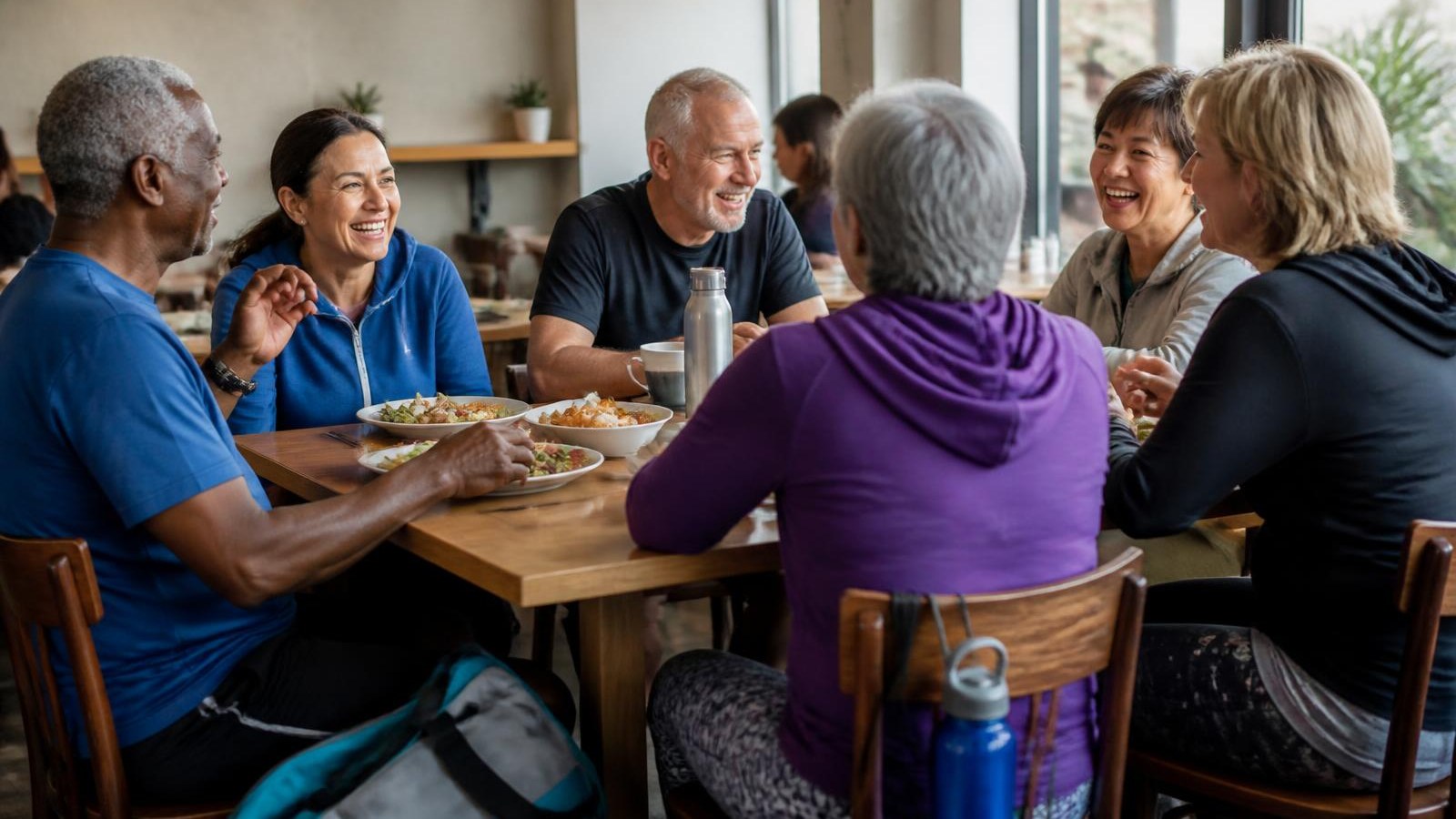
Why don't we have lunch after class?
There wasn't a plan.
I wasn't trying to start an organization.
I certainly wasn't thinking about building a community.
I just thought it would be nice to sit down together and actually get to know some of the people we'd been exercising beside.
So we did.
People showed up.
We talked.
We laughed.
We learned each other's names.
Then we did it again.
And somewhere along the way, something changed.
We weren't simply people who took the same fitness classes anymore.
We were becoming friends.
More than ten years later, what became the Y Gang has included people in their twenties, sixties, eighties and just about everywhere in between.
We've shared fitness classes, cycling, lunches, events, celebrations and a lot of laughs.
And it all started with something incredibly ordinary.
Lunch.
Sometimes connection begins when someone decides to turn familiar faces into people who know each other's names.
The rooms used to find us
When we're younger, life seems to put people in front of us automatically.
School does it.
Work does it.
Our children's activities can do it.
Teams, businesses and organizations do it.
We don't necessarily have to think about creating a social circle, because life keeps placing us in rooms with other people.
Then the rooms change.
A career changes.
Children grow up.
People retire.
Schedules loosen.
And suddenly nobody is automatically putting the same group of people in the same place every day.
Here's the part I think we get wrong.
We tend to describe that as a personal decline. I've become less social. I've let things slide.
It isn't a character change. It's a structural one.
Sociologist Reuben Thomas ran what he describes as the first U.S. survey to ask adults how they actually met the friends they most often socialize with, and the pattern is clear across the life course. In youth, friendships come overwhelmingly from school. In midlife, work becomes the centre. And later in life, the most common sources shift again — toward neighbours and voluntary groups.
Read that last part carefully, because it's the good news.
The social infrastructure doesn't disappear.
It relocates.
It moves from structures that were handed to us toward structures we choose.
Which means the question isn't whether we're still capable of making friends at fifty, sixty or seventy.
The question is which rooms we're choosing now that nobody is choosing them for us.
I've learned that being around people and actually knowing people are two very different things.
We proved that in those fitness classes.
We were together all the time.
But somebody still had to suggest lunch.
Alone, lonely, and something in between
Most of the conversation about this subject collapses into two words: alone and lonely.
They aren't the same thing, and neither one describes most of the people I know.
There's being alone, which plenty of us genuinely enjoy.
There's loneliness, which is the ache of wanting connection you don't have.
And in between there's a whole middle that almost nobody talks about.
Having acquaintances — people you recognize, nod to, exchange a few words with.
Having people to do things with — someone to ride with, walk with, meet for coffee, go to the thing you already wanted to go to.
And belonging somewhere — a place where you're expected, where somebody notices you missed a week.
Most of the capable, busy people I know aren't lonely at all.
They know plenty of people.
They've simply noticed that the number of people they actually do things with has quietly gotten smaller.
That's not a deficiency. That's a design problem.
And it's worth saying plainly: this was never about volume.
Nobody needs dozens of friends.
A handful of people you genuinely do things with is a rich life.
Why "put yourself out there" doesn't work
The standard advice is to put yourself out there.
I've never met anyone that advice helped.
Partly because it isn't advice. It's a verdict — you're the problem, try harder.
And partly because of what it actually asks you to do.
It asks you to walk into a room of strangers with no shared purpose, and perform.
Then there's the other version, borrowed from work. Network. Build your circle. Expand your connections.
That vocabulary makes sense when you want something from people.
It's terrible for friendship, because friendship isn't transactional and everyone can tell when it's being treated that way.
And the deepest problem with all of it is this.
Making friends feels strangely formal when making friends is the actual objective.
Two adults meeting for the explicit purpose of becoming friends is one of the most awkward things I can imagine. 😂
There's no shared activity to talk about.
No reason to be there other than the objective itself.
No natural reason to see each other again next week.
So the effort goes up, the ease goes down, and most people quietly decide they're just not good at this anymore.
They're fine at it.
The structure is missing.
It's easier when friendship isn't the point
Fitness happened to be our doorway.
It could have been anything.
A cycling club.
A walking group.
Volunteering.
Pickleball.
A neighbourhood gathering.
A book club.
A choir.
Or a group of people who meet for coffee every Thursday morning.
The activity gives people a reason to show up — and, more importantly, a reason to be there together again.
There's research pointing the same way. Jeffrey Hall's work in the Journal of Social and Personal Relationships on how friendships actually develop found that closeness tracks with time spent together — and that not all time counts equally. Time spent in shared leisure activity, hanging out and enjoying something together, was associated with growing closer. Time spent merely co-located, in the same place for other reasons, wasn't.
Which describes our fitness class perfectly.
We were co-located for years.
We got closer over lunch.
You take the class.
Ride the bike.
Walk the trail.
Volunteer.
Have lunch.
And somewhere along the way, conversations happen.
Names become familiar.
Inside jokes develop.
Someone notices when you're missing.
Eventually something changes.
At first, you show up for the activity. Eventually, you start showing up for the people.
That's what happened with us.
Fitness brought us into the same room.
The relationships are what turned it into something else entirely.
Showing up again next week
If I had to point to one ingredient, it wouldn't be effort.
It would be recurrence.
Something that happens again.
Same class. Same ride. Same Thursday. Same table.
Recurrence does the work that effort can't, because it removes the two hardest parts of adult friendship.
You don't have to make a plan every time.
And you don't have to be interesting on demand — you'll see these people again next week, so nothing has to happen today.
That's also how recognition builds.
The first week, you're a stranger.
The fourth week, you're a familiar face.
By the tenth, somebody asks where you've been.
I'm not offering that as a formula, and there's no schedule to follow. It just happens to be how it works.
There's something powerful about walking into a place and people knowing who you are.
Someone says hello.
Someone asks where you've been.
Someone notices you missed a class.
Someone expects you on the next ride.
Not because anyone is keeping attendance.
Well... except for our unofficial Y Gang rule: attendance at events is mandatory. 😂
It's a joke.
Mostly. 😂
But that's part of what makes a group feel like a group.
Over time, groups develop their own language, jokes and traditions.
Little things that might mean nothing to someone on the outside but make perfect sense to the people who are part of it.
They tell somebody something incredibly simple.
We see you.
You belong here.
Join something, or start something very small
There are only two doors, and both of them count.
You can join something that already recurs.
Or you can create the smallest possible recurring thing.
Joining is the easier door, and it's usually the right one. Someone else already handles the schedule, the location and the reason to be there. You just have to keep arriving.
If it's something you've never done before, that's not a disadvantage. Being a beginner is a perfectly good way to walk into a room — everyone there had a first week too.
The second door is smaller than people think.
A ride.
A walk.
A Thursday coffee.
Lunch after class.
That's it. That's the whole thing. You are not launching an organization, and there's no need to think of it as building anything.
You're just making an invitation that can happen again.
And this is where I'd point at one number, because it says something useful. The National Institute on Ageing's 2025 Ageing in Canada Survey found that only 33% of Canadians fifty and older took part in a social, recreational or group activity at least once a week — down from 39% the year before. Among the barriers people reported was a strikingly simple one.
Not having anyone to go with.
I find that oddly encouraging.
Because it means the room you're hesitating to walk into is full of people who hesitated too.
And it means the smallest possible invitation — want to come with me? — solves the exact problem a lot of people are naming.
Being useful is a door, not a fee
Something else I've noticed, and I want to be careful with it.
Contributing something deepens belonging.
When you help organize the ride, welcome somebody new, remember a birthday or post the photo that makes everyone laugh, you stop being a participant and start being part of it.
That's real, and it's part of what you do with everything you've learned.
But contribution is a door, not a fee.
Nobody has to earn their place in a group by being useful.
Some people organize. Some encourage. Some bring ideas, or energy, or humour.
And some simply keep showing up, which is a genuine contribution all by itself.
I've always enjoyed organizing.
I like getting people excited.
I like bringing people together.
I like seeing an idea become an experience.
But here's something important.
I didn't build the Y Gang.
We did.
Other people stepped forward.
They organized things.
Shared ideas.
Helped with events.
Welcomed people.
Encouraged each other.
And brought their own personalities, energy and humour.
What may have started with one invitation became a team effort.
It stopped belonging to whoever started something and started belonging to everyone.
Over the years, people have occasionally assumed I worked for the Y.
I don't. 😂
I've simply been involved.
Age becomes surprisingly unimportant
One of my favourite things about the Y Gang is the range of people I've gotten to know.
We've had people in their twenties.
People in their sixties.
People in their eighties.
And just about everywhere in between.
In many parts of life, those people might never naturally become friends.
Different generations.
Different careers.
Different backgrounds.
Different life experiences.
But put everyone in the same fitness class, on the same bicycle ride or around the same lunch table, and those differences become much less important.
You laugh about the same things.
You encourage each other.
You share experiences.
You learn from each other.
Somebody half your age can become a friend.
So can somebody twenty years older.
I've developed friendships this way that I probably never would have had through my working life.
That's one of the unexpected gifts.
It doesn't just give you more people to know.
It gives you different people to know.
People whose paths might never have crossed yours otherwise.
What the people part makes possible
We think carefully about health. About money. About work and what comes after it.
The people part usually gets left to chance — which is strange, because it changes everything else.
It's easier to stay active when someone is waiting for you on the ride. My cycling started as a solitary purchase and quietly turned into one of the most social parts of my life.
It's easier to have things on the calendar when other people are in them. Much of what I look forward to involves somebody else.
And it's easier to work out who you are next when you're around people who know you as you are now, rather than as the job you used to hold. That was the piece I didn't expect during the couple of years when I tried retirement.
I wasn't inactive. Far from it. During cycling season I was often riding 250 to 300 kilometres a week.
I had freedom. I had things to do.
But activity alone wasn't everything I needed.
I still wanted to contribute. To be part of a team. To matter somewhere.
That's when I realized there's a difference between having something to do and having somewhere you matter.
I've always enjoyed building.
Businesses.
Systems.
Ideas.
Experiences.
But building doesn't always mean creating something you can sell.
The best thing you build next might not be a business.
It might be a group of people who look out for each other — something nobody owns, which is part of what you do with everything you've learned.
Eventually, some of the titles and structures that once made us feel useful change.
Our ability to encourage, organize, mentor, introduce, invite and make somebody laugh doesn't change with them.
Those abilities don't retire unless we decide they do.
Who wants to grab lunch?
People sometimes talk about finding their community as though it's out there somewhere waiting to be discovered.
Sometimes it is.
But often the people who could become part of your next chapter are already around you.
The people you see at the gym.
The cyclists you ride beside.
The neighbours you wave to.
The people in the walking group.
The volunteers you see every week.
The familiar faces at the community centre.
People you recognize.
People you've probably smiled at.
People whose names you might not even know.
More than ten years ago, we were a group of people taking fitness classes together who didn't know each other's names.
Somebody suggested lunch.
People showed up.
Then they kept showing up.
Friendships formed.
Inside jokes developed.
And somewhere along the way, it became ours.
If any of this landed, there's really only one thing to do with it.
Put one recurring thing involving other people on your calendar.
Not a plan. Not a strategy. One thing that happens again.
And if you're not sure what it should be, the questions are pretty simple. What do you actually enjoy? Where is it already happening near you? And who could you ask to come along?
Nobody puts us in the same room anymore.
So we get to choose the room.
And maybe the question isn't:
Where do I find my community?
Maybe it's something much simpler.
Who wants to grab lunch?